






Date:
May 13, 2026
Author:
Syril Tiar
/
Best AI Prospecting Tools for B2B in 2026: Comparison, Examples and Method to Generate More Qualified Leads
In 2026, B2B sales prospecting can no longer rely only on an Excel spreadsheet, a few LinkedIn searches and a manually sent email sequence. Sales teams now need to deal with a more complex environment: artificial intelligence, data enrichment, responsible scraping, automation, multichannel sequences, personalization at scale and CRM tracking.
This transformation does not only concern growth teams or SaaS startups. It also impacts sales representatives, business developers, marketing managers, SME founders and training organizations looking to modernize their B2B acquisition strategy.
This article is also based on concrete field experience. Last winter, I delivered a course at EURIDIS in Toulouse, working with students trained in business development, B2B marketing and complex sales. Over several sessions, we explored the new uses of AI, growth hacking and prospecting tools in a real commercial context.
The goal was not simply to present a list of tools, but to teach a method: defining an ICP, finding the right accounts, identifying decision-makers, enriching contacts, personalizing messages, automating follow-ups intelligently and measuring results.
This educational approach can also be reproduced with sales teams, SDRs, business developers or executives who want to structure their B2B prospecting with the right tools and the right methodology.
In this article, we will compare the best AI prospecting tools for B2B in 2026, with practical use cases, workflow examples and a simple method to choose the right tools depending on your sales maturity.
Why Use AI Tools for B2B Prospecting in 2026?
AI prospecting tools solve a very concrete problem: sales teams still spend too much time on manual, low-value tasks.
Searching for companies, checking contacts, finding the right decision-makers, enriching email addresses, preparing personalized opening lines, following up at the right time or updating the CRM are all essential but time-consuming actions.
In 2026, the best AI prospecting tools make it possible to:
- build more qualified prospect lists;
- automatically enrich contacts with reliable data;
- identify intent or buying signals;
- personalize messages at scale;
- automate email, LinkedIn or multichannel sequences;
- reduce targeting errors;
- prioritize the accounts most likely to convert;
- measure sales performance more accurately;
- connect prospecting activity to the CRM;
- improve sales team productivity.

The goal is not simply to “save time”. The real challenge is to improve targeting quality, message relevance and the ability to generate qualified meetings.
AI does not replace sales strategy. It accelerates what is already well thought out. Bad automated targeting remains bad targeting. A generic message sent at scale remains a generic message.
However, when strong market understanding, precise segmentation, enriched data and intelligent personalization are combined, the results can change significantly.
Field Experience: A Course on AI Prospecting Delivered at EURIDIS Toulouse
During the winter, I had the opportunity to deliver a course at EURIDIS in Toulouse, a school specialized in training students for careers in sales, business development and B2B selling - discover all my Digital Marketing and Sales courses here.
This experience allowed me to test a highly operational approach to modern prospecting with students who will use these methods in their future commercial roles.
The course was not limited to a theoretical presentation of tools. The goal was to show how artificial intelligence, automation and growth hacking methods can be integrated into a real sales process.
We worked on:
- defining an ICP, meaning the ideal customer profile;
- researching target accounts on LinkedIn and Sales Navigator;
- identifying the right decision-makers;
- enriching B2B data;
- creating structured prospecting files;
- writing personalized prospecting messages;
- using AI to create sales opening lines;
- building multichannel sequences;
- automating follow-ups responsibly;
- understanding GDPR and ethical sales limits;
- measuring the performance of outbound campaigns.

This experience at EURIDIS confirmed one essential point: tools are not enough. Students quickly understand how to use Clay, Apollo, Lemlist, Instantly, Kaspr or Sales Navigator, but the real difference lies in the method.
A good salesperson must know why they are targeting a company, which signal they should use to start the conversation and how to adapt the message to the prospect’s real context.
This is exactly the logic I can reproduce with sales teams in companies. The format can be adapted depending on the team’s level: introduction to AI tools, outbound campaign workshop, LinkedIn prospecting training, Clay or Apollo workflow structuring, email sequence improvement or full support on B2B lead generation.
Comparison of the Best AI Prospecting Tools for B2B in 2026
The B2B prospecting tools market has become very dense. Some tools help identify the right prospects, others enrich data, automate campaigns, personalize messages or manage sales opportunities.
Here are the main tools to know in 2026.

Clay: The Best Tool for Building Advanced Prospecting Workflows
Clay is now one of the most powerful tools for growth teams, sales ops teams and revenue teams that want to industrialize their prospecting. The platform highlights access to more than 150 premium data sources and AI agents capable of automating complex go-to-market workflows - discover Clay here.
Clay is especially relevant if you want to create advanced scenarios such as:
- identifying companies currently hiring a specific profile;
- detecting companies that have recently raised funds;
- enriching a list of accounts with the right decision-makers;
- automatically analyzing a company’s website;
- generating a personalized opening line based on a business signal;
- scoring accounts according to their sales potential;
- sending enriched data to a CRM or outreach tool.
Example of a Clay Workflow for B2B Prospecting
Here is a concrete workflow example that can be built with Clay:
- Import a list of target companies.
- Enrich each account with industry, company size, country and technologies used.
- Identify the CEO, Head of Sales, CMO or Marketing Director.
- Verify the professional email address.
- Use AI to summarize the company’s positioning.
- Detect a relevant signal: hiring, news, growth, new offer.
- Generate a personalized opening line.
- Export the leads to Lemlist, Instantly, Apollo, HubSpot or Salesforce.
Clay is therefore ideal for companies that want to go beyond a simple database and build a truly intelligent prospecting machine.

Clay Is Recommended If…
Clay is especially suited if:
- you already have a structured outbound approach;
- you want to personalize campaigns at scale;
- you work with several data sources;
- you need advanced workflows;
- you want to save time on research and enrichment;
- you have a growth, sales ops or revenue ops team.
Clay is not necessarily the easiest tool for beginners. However, for a mature team, it can become a very powerful lever.
Apollo.io: The All-in-One Platform to Prospect, Enrich and Engage
Apollo.io remains a very complete solution for sales teams that want to centralize contact search, enrichment, sales engagement and opportunity tracking.
Apollo positions itself as an AI sales platform designed to prospect, generate leads and automate part of the sales process.
One of Apollo’s main advantages is that it brings several components together in one tool:
- B2B database;
- contact search;
- data enrichment;
- email sequences;
- sales automation;
- scoring;
- prospect tracking;
- CRM integrations.
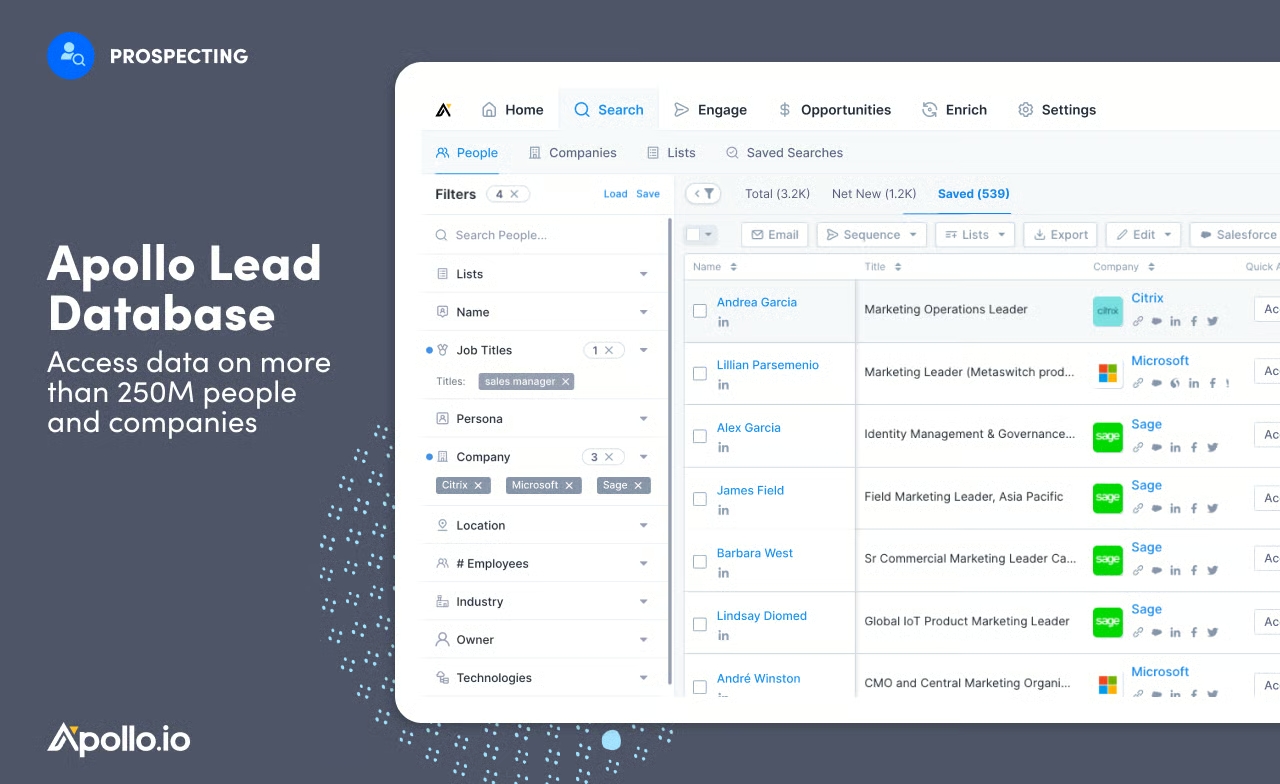
Apollo states that it provides a database of more than 230 million B2B contacts, with features for prospecting, enrichment and lead conversion - explore Apollo's full features here.
Example of How to Use Apollo.io
A sales team selling an HR SaaS solution can filter companies with 50 to 500 employees, based in France, with an identified HR department.
The team can then target HR Directors, Heads of People or Talent Acquisition Managers, create an email sequence and track replies directly inside Apollo.
Apollo.io Is Recommended If…
Apollo is relevant if:
- you are looking for a centralized solution;
- you want to avoid multiplying tools;
- you need a B2B contact database;
- you want to enrich your data;
- you want to launch sales sequences from the same environment;
- you are an SME, startup or sales team currently structuring your process.
Apollo is often a good balance between power, simplicity and speed of implementation.
Instantly: The Tool to Consider for Cold Email at Scale
Instantly has become an important player in B2B cold email. The platform highlights automated outreach, a B2B lead database, deliverability tools and an AI-powered CRM - get started with Instantly.
Instantly is especially adapted to teams that want to manage outbound email campaigns with significant volume while monitoring deliverability.
The tool can be used to:
- manage multiple sending inboxes;
- launch cold email sequences;
- track replies;
- test different opening lines;
- improve deliverability;
- centralize part of the leads and conversations;
- automate some follow-ups.
Instantly also highlights personalized sequences at scale, with smart sending account rotation and A/B testing.
Example of How to Use Instantly
A B2B agency can create several campaigns by segment:
- SME industrial company founders;
- consulting firms;
- SaaS startups;
- training organizations;
- software vendors;
- recruitment firms.
Each campaign can have a different value proposition, a specific email subject line and a personalization angle adapted to the segment.

Instantly Is Recommended If…
Instantly is especially useful if:
- your main channel is cold email;
- you manage several campaigns at the same time;
- you want to test different markets;
- you need strong deliverability monitoring;
- you want to structure email outreach at a larger scale.
The tool is powerful, but it must be used with judgment. Sending more emails is not a strategy in itself. Performance mainly comes from targeting, messaging and data quality.

Lemlist: An Effective Tool for Personalized Multichannel Sequences
Lemlist remains an interesting solution for teams that want to combine email, LinkedIn, calls, voice messages and manual tasks within multichannel campaigns.
Lemlist documentation highlights sequences combining email and LinkedIn, with a focus on personalization and managing touchpoints without over-soliciting prospects - explore Lemlist's multichannel sequences here.
Lemlist is particularly useful when message personalization is a key conversion lever.
Example of a Multichannel Sequence with Lemlist
A simple sequence could look like this:
- Day 1: personalized email with an opening line related to the company.
- Day 3: LinkedIn visit or interaction.
- Day 5: LinkedIn connection request.
- Day 7: email follow-up with a customer case.
- Day 10: short LinkedIn message.
- Day 14: final value-oriented follow-up.
This approach is more qualitative than a massive campaign. It works well for medium- or high-ticket offers, where each prospect deserves specific attention.

Lemlist Is Recommended If…
Lemlist is suitable if:
- you want to create multichannel campaigns;
- you use LinkedIn in your prospecting;
- you need to personalize messages;
- you target high-value accounts;
- you want to combine automation and manual actions.
Lemlist is especially interesting for teams that want to avoid prospecting that feels too cold or too automated.
LeoBizdev: The AI Sales Agent That Runs Prospecting Autonomously

Unlike most tools on this list, which give you data or automation to operate yourself, LeoBizdev positions itself as an AI sales agent that handles the prospecting work for you. Rather than adding another platform to manage, it runs outreach on LinkedIn and by email, surfaces qualified leads and organizes them into a clear pipeline — discover LeoBizdev here
This is a different philosophy from a database like Apollo or a workflow builder like Clay: instead of equipping the team, it acts as an autonomous layer on top of the prospecting process.
Example of How to Use LeoBizdev
A founder of a B2B SME with no dedicated sales team can let the agent identify relevant accounts, launch multichannel outreach on LinkedIn and email, and receive a steady flow of qualified leads to follow up on — freeing up several hours each week to focus on closing rather than chasing cold contacts.
LeoBizdev Is Recommended If…
LeoBizdev is especially relevant if:
- you are a founder or small team without a dedicated SDR;
- you want prospecting handled rather than tooled;
- you value time savings over granular manual control;
- you want LinkedIn and email outreach managed together;
- you prefer receiving qualified leads over building the workflow yourself.

LinkedIn Sales Navigator: Essential for Targeting the Right Decision-Makers
LinkedIn Sales Navigator remains a reference tool for identifying the right accounts and decision-makers.
The tool provides lead recommendations and intent signals based on user activity, helping salespeople identify new prospects.
Sales Navigator is often the first building block of a B2B prospecting strategy because it allows teams to work precisely on their ICP.
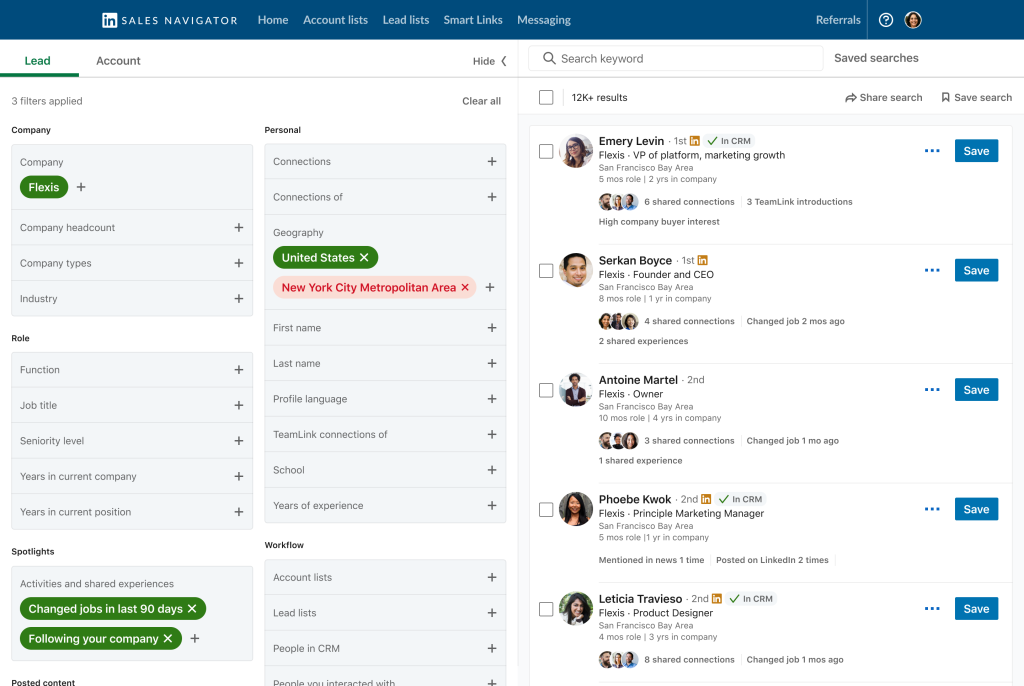
You can filter prospects by:
- job title;
- industry;
- company size;
- location;
- seniority level;
- tenure;
- job changes;
- saved accounts;
- intent signals.
LinkedIn also highlights Sales Navigator’s ability to identify high-potential leads based on targeting criteria and provide useful insights to start conversations - discover LinkedIn Sales Navigator here.
Example of How to Use Sales Navigator
A B2B acquisition consultant can create a list of SaaS companies with 11 to 200 employees in France, then target CEOs, CMOs or Heads of Growth.
This list can then be enriched through Clay, Kaspr, Dropcontact or Apollo before being used in an email or LinkedIn sequence.
Sales Navigator Is Recommended If…
Sales Navigator is useful if:
- LinkedIn is a central source of prospecting;
- you target B2B decision-makers;
- you want to create account lists;
- you need to identify the right contacts;
- you practice social selling;
- you want to track job changes or activity signals.
For many sales teams, Sales Navigator remains the starting point before enrichment and automation.

Complementary Tools to Enrich, Scrape or Automate Prospecting
Beyond Clay, Apollo, Instantly, Lemlist and Sales Navigator, other tools can complete a B2B prospecting stack.
They do not all serve the same purpose. Some help find contact details, others automate actions, clean data or structure LinkedIn prospecting.
Kaspr: To Quickly Find Contacts from LinkedIn
Kaspr is useful for retrieving professional contact details from LinkedIn profiles - try Kaspr for free here.
The tool can suit salespeople who want to quickly enrich prospects identified manually or through Sales Navigator.

Good Use Case for Kaspr
Kaspr is useful to:
- retrieve a professional email;
- find a direct phone number;
- enrich a LinkedIn prospect list;
- speed up sales qualification;
- complete a database before an outbound campaign.
Limitation to Keep in Mind
Contact data alone is not enough. Having an email or phone number does not mean the prospect is relevant.
You should always verify:
- job title;
- decision-making level;
- company context;
- potential interest;
- the right timing to contact the person.

PhantomBuster: To Automate Certain Data Collection Scenarios
PhantomBuster makes it possible to automate data collection, extraction and export actions across several platforms.
For example, the tool offers LinkedIn automations that can retrieve your network, filter profiles and use this data in prospecting scenarios - explore PhantomBuster's automations.
Examples of Automations Possible with PhantomBuster
PhantomBuster can be used to:
- export a list of LinkedIn profiles;
- retrieve company data;
- feed a Google Sheet;
- monitor certain accounts or profiles;
- create semi-automated prospecting scenarios;
- connect certain data points to a CRM.

Use with Caution
Scraping should always be used carefully.
You need to respect:
- platform terms of use;
- GDPR rules;
- commercial relevance of the targeting;
- volume limits;
- quality of the collected data.
A scraping tool should not become an excuse to industrialize intrusive prospecting.

Dropcontact: To Clean and Enrich B2B Data
Dropcontact is interesting for teams that want to improve CRM reliability, enrich contacts and reduce errors in sales files - discover Dropcontact's data enrichment features.

Good Use Case for Dropcontact
Dropcontact can be used to:
- clean an existing database;
- deduplicate contacts;
- find professional email addresses;
- enrich company records;
- improve CRM data quality;
- prepare a more reliable outbound campaign.
Data quality is a central topic. A poor database can damage deliverability, reduce reply rates and hurt sales credibility.

Waalaxy: To Automate Part of LinkedIn Prospecting
Waalaxy can be used to automate certain LinkedIn actions and create sequences combining invitations, messages and emails depending on the use case - get started with Waalaxy here.

Good Use Case for Waalaxy
Waalaxy can be useful to:
- launch a simple LinkedIn campaign;
- send targeted invitations;
- follow up with certain prospects;
- combine LinkedIn and email;
- test a sales approach on a specific segment.
Limitation to Keep in Mind
As with all LinkedIn automation tools, effectiveness depends heavily on targeting quality and message personalization.
Automating a bad message to the wrong target simply accelerates a bad process.
Which AI Prospecting Tool Should You Choose Based on Your Needs?
The best tool depends on your context. A SaaS startup, a B2B agency, a freelancer, an industrial SME or a structured sales team will not have the same needs.
Here is a simple framework to choose.
To Build an Advanced Outbound Machine: Clay
Clay is the best choice if you want to create advanced workflows, cross-reference several data sources, use AI agents and personalize messages at scale.
Ideal Profile
- growth team;
- sales ops;
- B2B agency;
- SaaS startup;
- company with a mature outbound strategy;
- revenue operations team.
To Centralize Everything in One Platform: Apollo.io
Apollo is suited to teams that want to prospect, enrich, engage and track their actions in one environment.
Ideal Profile
- B2B SMEs;
- structured sales teams;
- SDRs;
- business developers;
- growing startups;
- teams that want to limit the number of tools.
To Send Cold Email Campaigns: Instantly
Instantly is relevant if your main challenge is outbound email sending, managing multiple inboxes and deliverability.
Ideal Profile
- agencies;
- B2B freelancers;
- sales teams testing several markets;
- companies that want to structure email campaigns;
- teams that already have a qualified prospect database.
To Run Multichannel Prospecting: Lemlist
Lemlist is interesting if you want to combine email, LinkedIn, calls and manual follow-ups in more personalized sequences.
Ideal Profile
- B2B sales teams;
- high-value offers;
- complex sales;
- consulting firms;
- training organizations;
- sales agencies.
To Target Precisely on LinkedIn: Sales Navigator
Sales Navigator remains essential for identifying the right decision-makers and building account or prospect lists.
Ideal Profile
- B2B salespeople;
- consultants;
- recruiters;
- agencies;
- service providers;
- founders who prospect themselves.
Comparison Table of B2B AI Prospecting Tools
Example of an Effective AI Prospecting Stack in 2026
A strong strategy does not necessarily rely on one single tool. In many cases, the best performance comes from an intelligent combination of tools.
Simple Stack to Get Started
A simple stack may include:
- LinkedIn Sales Navigator to identify prospects;
- Kaspr or Dropcontact to enrich contact details;
- Lemlist or Instantly to send sequences;
- Google Sheets to initially track campaigns;
- HubSpot or Pipedrive to structure the pipeline;
- ChatGPT to help write messages.
This stack works well for a freelancer, a small sales team or a company starting with outbound prospecting.
Advanced Stack to Industrialize Prospecting
An advanced stack may include:
- Sales Navigator for account research;
- Clay for enrichment, scoring and AI personalization;
- Apollo to complete the contact database;
- Instantly for controlled-volume cold email;
- Lemlist for strategic multichannel campaigns;
- HubSpot, Salesforce or Pipedrive for CRM management;
- ChatGPT, Gemini or Perplexity for research, writing and analysis support.
This stack is better suited to companies that want to build a real lead generation system with a continuous improvement mindset.
Method to Succeed with AI Prospecting in B2B
Tools are important, but they do not replace methodology.
This is one of the points I worked on specifically during the course delivered at EURIDIS Toulouse: before launching a campaign, you must know exactly who you are targeting, why you are targeting them, with which message and with which objective.
Step 1: Define Your ICP Precisely
Before choosing a tool, you need to define your ICP, meaning your ideal customer profile.
Ask yourself the right questions:
- What type of company do we want to target?
- In which industry?
- With what team size?
- In which geographical area?
- With what business challenges?
- Which decision-makers should we contact?
- Which signals indicate that an account is a priority?
- Which sales or marketing pain point can we solve?
- What maturity level should the target company have?
A clear ICP prevents teams from automating prospecting that is too broad and ineffective.
Step 2: Identify Useful Sales Signals
The best prospecting workflows are no longer based only on job title or industry. They use signals.
Examples of useful B2B signals include:
- ongoing hiring;
- fundraising;
- leadership change;
- new product launch;
- rapid team growth;
- adoption of a specific technology;
- website visit;
- content download;
- LinkedIn interaction;
- recent company news;
- new office opening;
- participation in a trade show;
- change of provider.
LinkedIn Sales Navigator highlights intent signals as a way to help salespeople identify accounts and prospects to contact at the right time.
Step 3: Personalize Without Falling into Fake Personalization
AI can help write messages, but it can also generate generic opening lines if poorly used.
A good prospecting message should show:
- that you understand the company’s activity;
- that you are contacting the right person;
- that your proposal is linked to a concrete challenge;
- that you are not sending a copy-paste message;
- that the prospect can quickly understand the value of your outreach.
Example of a Bad Opening Line
“I saw that you are an innovative company in your industry.”
This sentence is too vague. It could be sent to anyone.
Example of a Better Opening Line
“I saw that you are currently hiring two SDR profiles in Lyon. This is often the moment when teams start structuring their prospecting tools and outbound sequences.”
This approach is more credible because it is based on an observable signal.
Step 4: Build a Coherent Sequence
A good prospecting sequence does not mean aggressively following up every two days.
It should create a logical progression:
- First contact with a personalized angle.
- Follow-up with proof or evidence.
- LinkedIn interaction or social signal.
- Follow-up with a use case.
- Short and respectful final message.
The goal is to remain visible without becoming intrusive.
Step 5: Measure the Right Indicators
A prospecting campaign should not be judged only on open rate. In 2026, this metric is becoming less reliable.
Instead, track:
- reply rate;
- positive reply rate;
- number of meetings generated;
- cost per meeting;
- conversion rate into opportunity;
- conversion rate into customer;
- quality of engaged accounts;
- deliverability;
- unsubscribe rate;
- complaint rate;
- average response time;
- revenue generated.
The goal is not to send more. The goal is to create more qualified opportunities.
Practical Example: Building an AI Prospecting Campaign from A to Z
Let’s imagine a company selling a B2B sales training solution.
Campaign Objective
Generate meetings with sales directors, training managers or SME founders who want to modernize their prospecting methods.
Targeting
The target could be:
- B2B companies with 20 to 300 employees;
- sectors: SaaS, consulting, business services, industry;
- location: France;
- decision-makers: CEO, Head of Sales, Sales Manager, Training Manager;
- signals: sales hiring, LinkedIn growth, new offer, geographic expansion.
Possible Workflow
Here is a simple workflow:
- Search for accounts in Sales Navigator.
- Qualify companies.
- Enrich data in Clay or Apollo.
- Verify emails with Dropcontact or an equivalent tool.
- Analyze the website with AI to identify an outreach angle.
- Create a personalized message.
- Send the sequence through Lemlist or Instantly.
- Follow up on LinkedIn.
- Track replies in the CRM.
- Analyze performance after two to three weeks.
Example of a Personalized Message
Subject: your sales hiring
Hello {{First name}},
I noticed that {{Company}} is currently hiring for sales roles. This is often a key moment to structure prospecting methods, follow-up sequences and the use of AI tools within sales teams.
I support B2B teams on these topics: targeting, lead generation, responsible automation and message personalization.
Is improving your sales prospecting process one of your current priorities?
Best regards,
{{Signature}}
This type of message works better than a generic email because it starts from a specific context and opens a natural sales conversation.
Training Sales Teams on AI Tools for B2B Prospecting
AI prospecting tools are evolving quickly. For a sales team, the risk is not only failing to use them, but using them without a method.
The most common mistakes are often the same:
- poor targeting;
- generic messages;
- excessive automation;
- poor data quality;
- lack of CRM follow-up;
- non-compliance with prospecting rules;
- confusion between volume and performance.
This is why operational training can save a lot of time.
Based on the experience carried out at EURIDIS Toulouse, it is possible to build a program adapted to sales teams, SDRs, business developers, marketing managers or B2B executives.
Possible Objectives of an AI Prospecting Training Program
A training program can help teams:
- understand the main AI prospecting tools on the market;
- choose the right tools according to their sales cycle;
- build a clear and usable ICP;
- use LinkedIn and Sales Navigator to identify the right prospects;
- enrich data with suitable tools;
- create personalized messages with the help of AI;
- structure email and LinkedIn sequences;
- automate without damaging the sales relationship;
- respect GDPR rules;
- track results in a CRM or sales tracking file.
Examples of Workshops That Can Be Reproduced in Companies
Here are some formats that can be offered to sales teams:
- workshop: “Build your ICP and target account lists”;
- workshop: “Prospect effectively with LinkedIn Sales Navigator”;
- workshop: “Create an outbound campaign with Lemlist or Instantly”;
- workshop: “Use Clay or Apollo to enrich and qualify leads”;
- workshop: “Write prospecting messages with ChatGPT”;
- workshop: “Create an automated Google Sheets prospecting file”;
- workshop: “Measure and improve sales campaigns”;
- workshop: “Structure your CRM to better track generated leads”.
The value of this type of training is that teams leave with directly usable assets: a clarified target, a better structured prospect database, messages ready to test, a follow-up sequence and a tracking method.
Which Teams Can Benefit from This Training?
This training can be useful for:
- sales teams;
- SDRs;
- business developers;
- B2B marketing managers;
- SME founders;
- consultants;
- agencies;
- training organizations;
- SaaS startups;
- revenue operations teams.
The goal is not to turn salespeople into technicians, but to give them the right habits to use AI better, target better and sell better.
My conclusion on the Growth Hacking needs in a B2B environment
Need to train your sales teams on AI prospecting?
After delivering a course on these topics at EURIDIS Toulouse, I also support sales teams, SDRs and business developers in learning how to use AI tools for B2B prospecting: LinkedIn Sales Navigator, Clay, Apollo, Lemlist, Instantly, ChatGPT, data enrichment, outbound sequences and CRM structuring.
The objective: help your teams build more targeted, more personalized and more effective prospecting. Discover my customized training programs in Digital Marketing and B2B Sales.
AI Prospecting, GDPR and Ethics: Best Practices to Follow
Sales automation must remain controlled.
In France, the CNIL reminds companies that commercial prospecting by email is possible, but individuals must be informed and must be able to object to the use of their data when dealing with professionals - read the CNIL guidelines on prospecting.
For healthier B2B prospecting, apply these principles:
- target only relevant contacts in a professional context;
- clearly explain why you are contacting the person;
- avoid excessive volumes;
- offer a simple unsubscribe option;
- do not hide your identity;
- keep clean and justified data;
- avoid enriching or using sensitive data;
- respect platform terms of use;
- document your data sources;
- delete contacts who no longer wish to be contacted.
The European AI Act should also be monitored. The European Commission states that the AI Act entered into force on August 1, 2024, with several provisions applying progressively from 2026 - read the full EU AI Act details.
In other words: AI in sales should be used as an efficiency lever, not as an excuse to industrialize intrusive practices.
Common Mistakes with AI Prospecting Tools
Even with the best tools, many teams achieve poor results because they do not structure their approach properly.
Mistake #1: Choosing the Tool Before the Strategy
Many teams start by buying a tool before clarifying their target, offer and message.
This is a mistake.
A tool does not fix poor positioning.
Before choosing Clay, Apollo, Lemlist or Instantly, you need to answer these questions:
- Who do we want to target?
- Why this target?
- What problem do we solve?
- What message are we going to test?
- Which channel is the most relevant?
- Which metric will determine performance?
Mistake #2: Sending Too Many Generic Messages
Automation sometimes creates the illusion that increasing volume is the solution.
In reality, the more prospects are contacted, the more relevance matters.
It is better to send 500 well-targeted messages than 5,000 messages with no context.
Mistake #3: Neglecting Data Quality
Poor data leads to:
- invalid emails;
- messages sent to the wrong people;
- duplicates;
- poor sender reputation;
- loss of sales credibility;
- lower reply rates.
Data enrichment and cleaning are therefore strategic steps.
Mistake #4: Not Connecting Prospecting to the CRM
If generated leads are not tracked properly, sales performance becomes impossible to manage.
Each prospect should be tracked according to their status:
- contacted;
- followed up;
- interested;
- meeting booked;
- opportunity created;
- lost;
- customer.
Without a CRM or a clean tracking file, a prospecting campaign quickly becomes difficult to analyze.
Mistake #5: Confusing Automation with Sales Relationships
Automation should support the salesperson, not replace them.
A good workflow should free up time for high-value actions:
- strategic research;
- meeting preparation;
- understanding the prospect;
- personalizing exchanges;
- sales follow-up;
- closing.
The sales relationship remains human. AI simply helps prepare better, target better and prioritize better.
Do You Absolutely Need Paid Tools to Prospect with AI?
No. It is possible to start with a simple approach using Google Sheets, LinkedIn, ChatGPT and a few enrichment tools.
A well-structured Google Sheets file can already be used to track:
- target companies;
- decision-makers;
- LinkedIn URLs;
- emails;
- detected signals;
- messages sent;
- follow-up dates;
- replies;
- sales statuses;
- next contacts;
- created opportunities.
This is also an interesting approach in training. Before deploying an expensive stack, teams can learn to structure their sales reasoning in a simple tool.
The essential point is to know what you are trying to automate. Automating a bad method only amplifies its flaws.
Conclusion: The Best AI Tools Do Not Replace Sales Methodology
In 2026, sales skills are no longer only about knowing how to sell. They also involve knowing how to design a complete prospecting system: identify, enrich, prioritize, personalize, contact, follow up, measure and improve.
Clay, Apollo, Instantly, Lemlist, Sales Navigator, Kaspr, PhantomBuster, Dropcontact or Waalaxy can all have a place in a B2B lead generation strategy.
But their effectiveness always depends on three elements:
- targeting quality;
- message relevance;
- the ability to create a real sales relationship.
AI does not replace strategic thinking. It accelerates teams that already know who they are targeting, why they are contacting them and what value they can bring.
This approach is not only based on market research and tool monitoring. It is also based on concrete teaching experience at EURIDIS Toulouse, where I delivered a winter course dedicated to B2B prospecting, growth hacking and AI tools.
This methodology can now be adapted and reproduced for sales teams that want to professionalize their lead generation, modernize their practices and make better use of artificial intelligence in their daily prospecting.
The right tool is therefore not necessarily the most complete one. It is the one that matches your maturity level, your sales cycle, your acquisition channels and your way of selling.
What Is the Best AI Tool for B2B Prospecting in 2026?
Clay is one of the best tools for building advanced AI prospecting workflows. Apollo.io is more suitable if you are looking for an all-in-one platform. Instantly is relevant for cold email, while Lemlist is better suited to personalized multichannel sequences.
Which Tool Should You Choose Between Clay and Apollo?
Clay is more powerful for advanced enrichment, sales signals and AI personalization. Apollo is easier to use if you want to centralize the contact database, enrichment and sales sequences in a single tool.
Which Tool Should You Use for B2B Cold Email?
Instantly and Lemlist are two strong options. Instantly is interesting for managing email campaigns at a larger scale, while Lemlist is better suited to personalized and multichannel campaigns.
Can You Automate LinkedIn Prospecting?
Yes, but with caution. Tools like Sales Navigator, Waalaxy, Kaspr or PhantomBuster can help identify, enrich or automate certain actions. However, you must respect platform limits, GDPR and avoid overly aggressive behavior.
Can AI Write Prospecting Messages?
Yes, but it should be used as an assistant. The best messages remain those based on a real sales signal, a specific context and a clear value proposition.
Are AI Prospecting Tools GDPR-Compliant?
It depends on how they are used. A tool may offer useful features, but the company using it must ensure that its prospecting complies with applicable rules: targeting relevance, information provided to individuals, legal basis, unsubscribe mechanism and responsible data management.
Can You Train a Sales Team on AI Prospecting?
Yes. Training can help a sales team better use AI tools, structure its ICP, create prospect lists, personalize messages, automate follow-ups and track performance. This is precisely the type of approach I implemented during a course delivered at EURIDIS Toulouse during the winter.syril