








Date:
June 4, 2026
Author:
Syril Tiar
/
How We Create 30+ Short Videos Per Week Using AI (And How Our Clients Use the Same System to Grow Their Communities)
Most businesses know they should be creating more video content.
The problem is that creating content consistently is expensive, time-consuming and often unsustainable.
A marketing team may spend several hours filming a webinar, an interview or a podcast episode, only to publish it once and move on to the next project.
That's a massive waste of content potential.
At Syril Digital, we use artificial intelligence to transform a single long-form recording into dozens of short-form videos every week. This system allows us to increase visibility, maintain publishing consistency and significantly reduce production costs.
More importantly, we've implemented the same methodology for clients across different industries, helping brands build engaged communities while maximizing the value of every piece of content they create.
In this article, we'll break down the exact workflow we use, the tools involved, the costs, the results and the lessons we've learned after years of experimentation.
Why Most Companies Struggle With Video Content
Creating content isn't the problem. Maintaining consistency is.
Most businesses start with good intentions:
- One LinkedIn post per week.
- A few Instagram Reels.
- Some TikTok experiments.
- An occasional video interview.
Then reality hits. Filming takes time. Editing takes time. Creating subtitles takes time. Publishing takes time.
And eventually, content creation becomes an occasional marketing activity instead of a growth system.
The result is predictable:
- Inconsistent visibility.
- Slow audience growth.
- Reduced brand authority.
- Lower organic reach.
The challenge isn't creating more content. The challenge is creating more leverage.
The Core Principle: One Recording, Multiple Assets
Most businesses think in terms of content pieces. We think in terms of content assets.
A single webinar can become:
- 30 short videos
- 10 LinkedIn posts
- 5 newsletter topics
- 3 blog articles
- 1 lead magnet
- Multiple social media carousels
Instead of producing content one piece at a time, we create content ecosystems. This dramatically improves return on investment.
The Workflow We Use at Syril Digital
Our production process follows five main stages.
Stage 1: Record Long-Form Content
The best source material usually includes:
- Podcasts
- Interviews
- Webinars
- Workshops
- Training sessions
- Founder stories
- Industry analyses
The ideal duration is between 30 and 90 minutes. The longer and richer the discussion, the more opportunities there are to extract valuable short-form clips.
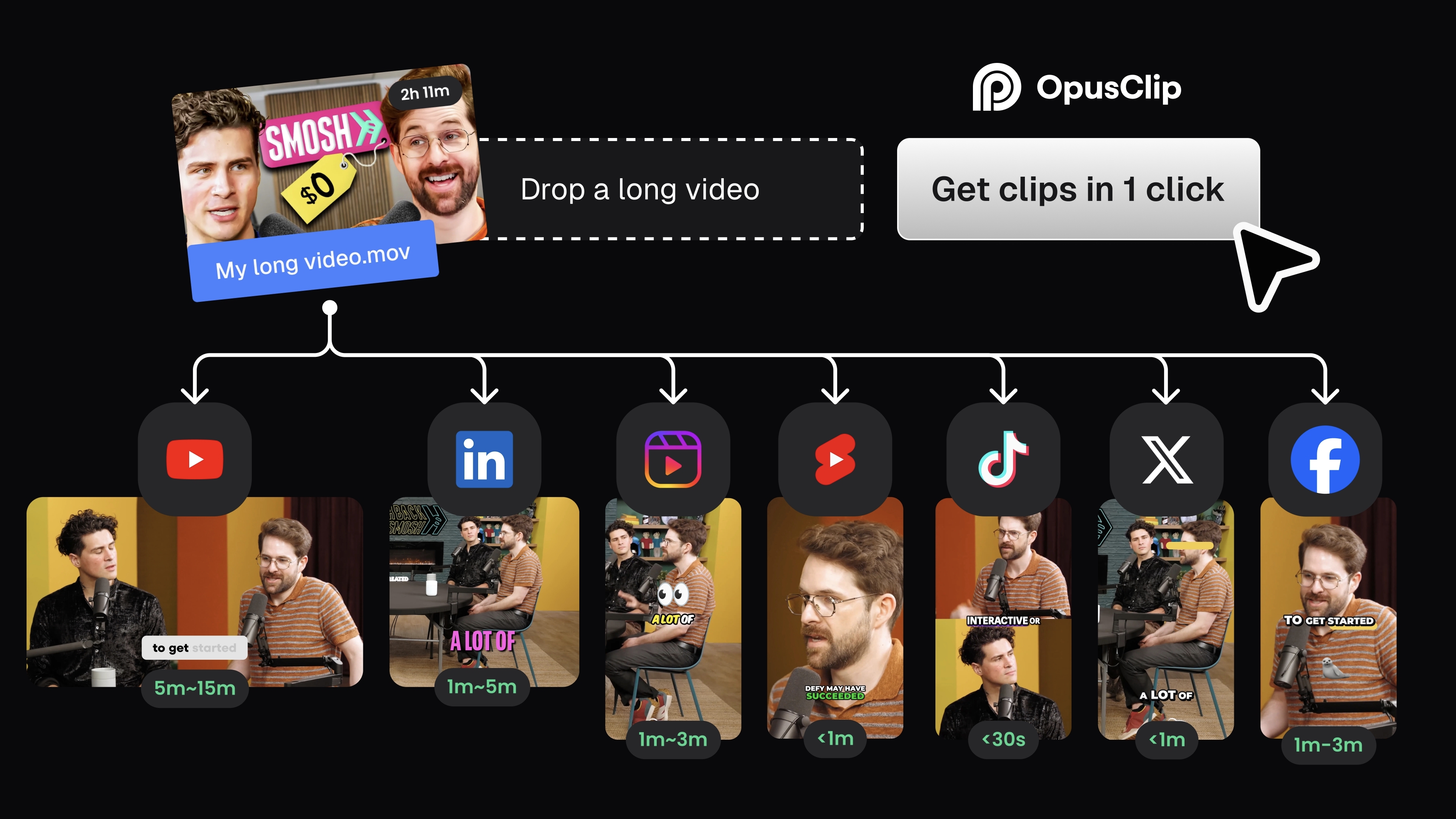
Stage 2: Upload the Recording to OpusClip
For several years, OpusClip has been one of the central tools in our video repurposing workflow.
The platform automatically:
- Detects engaging moments
- Generates captions
- Creates vertical video formats
- Scores clip potential
- Identifies strong hooks
- Produces multiple versions
Without AI, this process would require several hours of manual work.
Stage 3: Human Review
This is where most businesses misunderstand AI. AI helps us move faster. It does not replace strategic thinking.
Every clip is reviewed by a human before publication. We verify:
- Accuracy
- Context
- Brand consistency
- Tone of voice
- Relevance
This step is essential. The difference between average content and high-performing content often comes down to editorial decisions.
Stage 4: Platform Adaptation
Each social network has its own audience expectations.
- TikTok prioritizes entertainment and fast hooks.
- Instagram values aesthetics and lifestyle content.
- LinkedIn rewards expertise and professional insights.
- Facebook often performs well with educational and community-focused content.
Publishing the exact same clip everywhere is rarely the best approach.
Stage 5: Distribution and Scheduling
Once the clips are finalized, they enter a publishing calendar. This ensures consistency without requiring constant production.
The goal is not to publish more. The goal is to publish smarter.
Case Study #1: How We Helped Bibim Pop Build a 50,000+ Follower Community
One of the most visible examples of this methodology is Bibim Pop. The brand operates in the Korean food sector and relies heavily on social media visibility to educate customers, increase awareness and generate engagement.
By combining:
- Content strategy
- Community management
- Short-form video
- AI-assisted content production
the brand developed a community exceeding 50,000 followers across:
- TikTok
The key lesson was not that AI created growth. The key lesson was that AI allowed the team to maintain consistency at a sustainable cost.
Instead of constantly searching for new content ideas, the team could extract multiple pieces of content from existing recordings and events.
Case Study #2: Building Trust and Authority for Maison Bellea
Maison Bellea operates in a completely different environment. Unlike food brands, the objective is not simply entertainment or visibility. The challenge is building trust.
For Maison Bellea, content often focuses on:
- Expertise
- Personal experiences
- Educational insights
- Lifestyle habits
- Client reassurance
Using the same repurposing workflow, longer discussions and interviews can generate multiple short-form videos addressing different audience concerns.
Instead of relying on one flagship video, the brand creates dozens of touchpoints throughout the customer journey. This increases familiarity and strengthens credibility over time.
The ROI of AI Content Repurposing
One of the most common questions we receive is: "Is the investment worth it?"
Traditional Workflow
One 60-minute webinar:
- Recording: 1 hour
- Editing: 4 hours
- Publishing: 1 hour
Total output: one video.
AI-Powered Workflow
One 60-minute webinar:
- Recording: 1 hour
- AI processing: 15 minutes
- Review: 1 hour
- Scheduling: 30 minutes
Total output: 20 to 50 clips, multiple social posts, future article ideas.
The productivity difference is substantial.
Comparing the Main AI Video Repurposing Tools
The Biggest Mistake Companies Make
The biggest mistake isn't failing to use AI. It's producing content without a system.
Many companies:
- Record random videos.
- Publish inconsistently.
- Measure nothing.
- Start over every month.
Successful brands do the opposite. They build repeatable content engines. AI simply makes those engines more efficient.
What About SEO?
Video repurposing also creates opportunities beyond social media. Every long-form recording can become:
- Blog content
- FAQ pages
- Resource guides
- Lead magnets
- Newsletter sequences
This creates a powerful synergy between content marketing, SEO and social media. Instead of operating in silos, each content asset feeds multiple acquisition channels.
Cost Analysis
Typical monthly costs for a small business:
- OpusClip: $20–$30/month
- Scheduling platform: $20–$50/month
- Cloud storage: $10–$20/month
For less than the cost of a few hours of manual editing, businesses can dramatically increase their publishing capacity. The return on investment often comes from time saved before it comes from direct revenue.
Final Thoughts
AI is changing content production. But the companies seeing the strongest results are not the ones using the most AI. They are the ones using AI to support an existing strategy.
At Syril Digital, we've learned that growth rarely comes from a tool alone. Growth comes from combining:
- Expertise
- Consistency
- Distribution
- Strategy
- Measurement
AI simply helps scale the process. And when implemented correctly, one recording can become weeks of valuable content.
Frequently Asked Questions
How many clips can one video generate?
Most recordings produce between 10 and 50 usable clips depending on the richness of the discussion.
Is OpusClip worth it for small businesses?
Yes, especially if content creation is already part of your marketing strategy.
Can AI replace a video editor?
No. It accelerates editing but does not replace strategic review.
Which platform should businesses prioritize?
It depends on the audience, but LinkedIn, Instagram and TikTok are often the strongest starting points for organic growth.
Does short-form video still work in 2026?
Absolutely. It remains one of the most effective content formats for visibility, engagement and brand awareness.